


The Legend of Queen Moremi Ajasoro – Yoruba Heroine of Ile-Ife

Historical Background
In 12th-century Ile-Ife, the cradle of the Yoruba people in what is now southwestern Nigeria, a dire threat loomed over the kingdom. Ile-Ife’s people were under attack by a neighboring tribe known in Yoruba oral history as the Forest People (called Ìgbò in Yoruba, not related to the Igbo ethnicity of Eastern Nigeria). These invaders staged relentless raids, enslaving scores of Ife inhabitants and striking terror into the populace. Clad from head to toe in eerie cloaks of dried grass and bamboo fiber, the raiders appeared more like supernatural beings than mortal warriors. The people of Ife, believing these mysterious marauders to be spirits or gods’ punishment, found themselves unable to resist – conventional weapons and tactics had failed, and panic gripped the city.
Amid this chaos rose Moremi Ajasoro, a woman of exceptional courage and wit. Moremi was a queen consort of Ile-Ife, married to King Ọ̀rànmíyàn (son of the legendary founder of the Yoruba, Oduduwa). Originally from Offa (in today’s Kwara State of Nigeria), she was renowned for her beauty, bravery, and keen intelligence. As the raids intensified, Moremi could no longer bear to see her people suffer. She understood that saving Ile-Ife would require ingenuity and sacrifice beyond ordinary means – and she was prepared to provide both.
The Folklore Story: Moremi’s Daring Sacrifice
Moremi devised a bold plan to liberate her people. According to Yoruba oral tradition, she sought spiritual help by consulting the river spirit of the Esimirin River. In a solemn prayer, Moremi vowed to the river god that she would surrender her most precious possession if only she could discover the secret to defeating Ile-Ife’s fearsome enemies. The votive pledge she offered was heartbreaking, she promised her only son, Oluorogbo, as a sacrifice should her mission succeed.
Empowered by spiritual resolve, Moremi set her plan in motion. She deliberately allowed herself to be captured by the forest raiders, trusting that her wits and beauty would keep her alive. Just as she anticipated, the invaders, struck by Moremi’s courage and grace, spared her life. In fact, her captors delivered her as a gift to their king, given her striking appearance and bearing. Before long, Moremi’s wisdom and charm won the admiration of the enemy ruler, who took her as his queen. Immersed in the heart of the adversary’s domain, the queen-from-Ife played her role perfectly – all the while quietly gathering intelligence that could save her people.
Over months in captivity, Moremi observed and probed. She learned everything about the raiders’ customs, tactics and weapons, always keeping her true purpose in mind. In intimate conversations (“pillow talk”), the enemy king eventually divulged the crucial secret Moremi sought: the warriors’ terrifying appearance was a ruse – beneath the raffia and grass disguises, they were ordinary men mortally vulnerable to fire. Because their battle garb was made of highly flammable fibers, a simple torch or flame could turn these so-called spirits into bonfires on the battlefield. This revelation was the key to Ile-Ife’s salvation.
Having learned all she could, Moremi seized an opportunity to escape back to Ile-Ife and return to her first husband, King Oranmiyan. She brought with her the invaluable knowledge of the invaders’ only weakness. When she explained that the enemy “spirits” were men who could be burned by fire, the Yoruba elders and warriors acted quickly. The next time the marauders attacked Ile-Ife, the defenders were ready. They brandished torches and flaming arrows, setting the grass-costumed raiders alight. Deprived of their supernatural aura and engulfed in flames, the invaders fell into chaos. Ile-Ife routed its oppressors, achieving a decisive victory that ended the terror of the Forest People once and for all.
With her mission accomplished, Moremi did not forget the divine pact that made it possible. In agony, she returned to the bank of the Esimirin River to fulfill her pledge to the deity that had granted her guidance. She first offered the river spirit lavish sacrifices of cattle and fowl – desperately hoping a lesser substitute might appease the god – but the spirit would accept nothing less than what was promised. Moremi was thus faced with the ultimate test of integrity and sacrifice. Keeping her vow, she surrendered her beloved son Oluorogbo to the river, giving up her own child to honor the bargain that saved her people. The enormity of this sacrifice grieved Moremi and all of Ile-Ife – they understood that their freedom had been purchased at the highest possible price. According to legend, the elders of Ile-Ife, moved by Moremi’s selflessness, vowed that she would forever be regarded as a mother to the Yoruba. They consoled her by declaring that all the people of the kingdom would be her children in place of Oluorogbo, a promise of eternal gratitude that the community keeps to this day.
Cultural Symbolism and Lessons of the Story
The tale of Moremi Ajasoro carries profound symbolism in Yoruba culture, imparting timeless lessons on leadership, sacrifice, and patriotism. At its core, Moremi’s story is a testament to selfless courage and the idea that true leadership often requires personal sacrifice. Moremi risked everything – even her life and the life of her only child – to save her people. Her willingness to “sacrifice everything” for the liberation of her people has made her a paragon of devotion in Yoruba folklore. The legend teaches that genuine love for one’s community means putting the common good above oneself, a value epitomized by Moremi’s vow and its heartrending fulfillment.
Moremi also symbolizes the power of wisdom and strategic thinking over brute force. Where the warriors of Ile-Ife failed through strength of arms, Moremi succeeded through intellect and bravery. Disguised as a captive, she used keen observation and cunning to discern the enemy’s weakness, proving that knowledge and strategy can overcome even seemingly invincible foes. This aspect of the story underscores the lesson that insight and ingenuity – often undervalued traits – are as heroic as martial valor. In Yoruba oral tradition, Moremi’s name thus stands for resourcefulness in the face of overwhelming odds.
Importantly, Moremi’s victory is also viewed through the lens of female empowerment and leadership. As a woman who saved an entire kingdom when men could not, she shattered the gender norms of her era. “Some women are so powerful that their deeds dwarf those of men in Yorubaland,” one Nigerian writer notes, pointing to Moremi’s example. Moremi’s tale emphasizes that courage, wisdom and strength are not the sole domain of men – a message that resonates in contemporary conversations about women’s roles in society. She is venerated as a folk heroine who combined “beauty, brains, and bravado” in equal measure. Her story instills pride and inspiration, especially among women, by showing a heroine who used her influence and resolve to protect her people.
Finally, the legend imparts a spiritual and moral lesson on the importance of honoring one’s promises. Even though fulfilling her vow cost Moremi her son, the story holds her up as an example of utmost integrity – a person who kept her word to the gods. This reflects a deep cultural value: that oaths and bonds, especially those made to divine forces, are sacred and must be upheld, even at great personal cost. Moremi’s life becomes a model of piety, courage, and sacrifice, inspiring the idea that the gods reward bravery but also demand accountability. The Yoruba regard her not merely as a historical figure, but as a moral exemplar whose life conveys the honor in sacrifice and the virtue of steadfast loyalty to one’s people.
Preservation and Legacy in Modern Times
Far from being a dusty old tale, the story of Moremi Ajasoro remains a living legend in Yoruba land today, actively preserved, celebrated, and reinterpreted for new generations. The primary way the community keeps her memory alive is through the annual Edi Festival in Ile-Ife, a major cultural event that has been held for centuries in her honor. Initiated shortly after Moremi’s death, the Edi (or Moremi) Festival commemorates her extraordinary sacrifice for the Yoruba people. During this festival, traditionally a week-long celebration, the people of Ife pay tribute to Moremi through ceremonies, dances, and narratives of her heroism. In fact, Moremi has been elevated to the status of an orisha-heroine (deified heroine) in the Yoruba spiritual pantheon, and a priesthood tends her shrine in Ile-Ife to this day. The festival is both a religious observance and a community celebration: it reinforces communal identity and teaches each new generation about Moremi’s bravery. To this day, prayers and praise are offered to honor “Moremi the savior of Ife” during Edi – underscoring how deeply her story is woven into the cultural and spiritual fabric of the city.
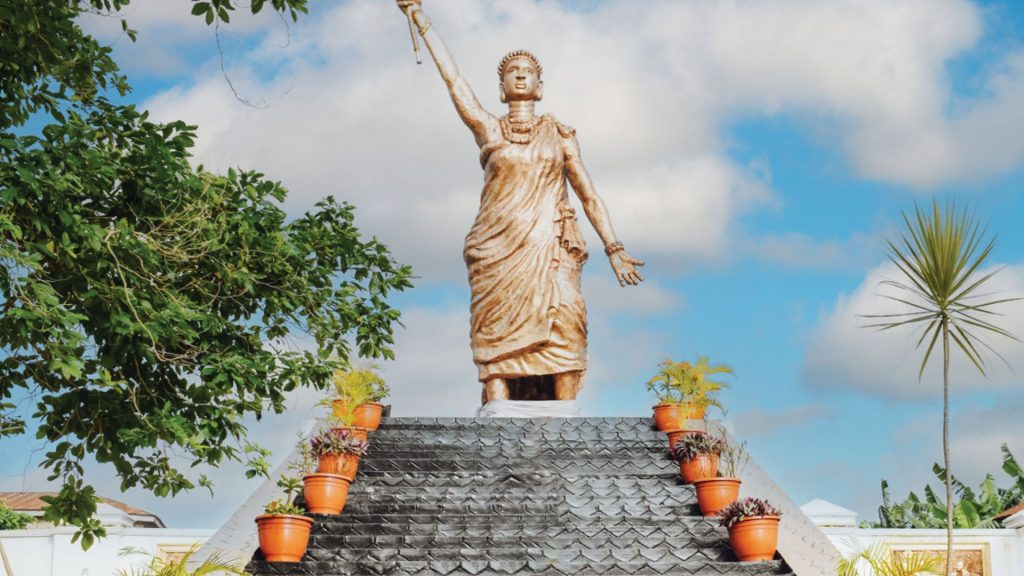
Modern Yoruba communities (and Nigeria at large) also celebrate Moremi’s legacy through various memorials, educational institutions, and arts. In 2017, the Ooni of Ife (the Yoruba monarch) unveiled a towering statue of Queen Moremi within his palace grounds – at 42 feet high, it is the tallest statue in Nigeria, cast in bronze to immortalize her image. This striking monument depicts Moremi with regal posture, symbolically greeting her people, and serves as a daily reminder in Ile-Ife of the queen’s watchful spirit over the kingdom. Across Yorubaland, Moremi’s name graces many institutions: for example, there are Moremi halls (dormitories) for female students at the University of Lagos and Obafemi Awolowo University (Ife) named in her honor. These namings reflect a conscious effort to inspire young women with Moremi’s virtues of courage and leadership.
The oral tradition of Moremi’s story has also been kept robust. Yoruba storytellers, griots, and parents continue to recount the tale around campfires and in classrooms, ensuring it is not forgotten. In recent years, the legend has been “remixed” for broader audiences through books, theater, and even digital media, often led by African creators. A notable example is Queen Moremi: The Musical, a lavish stage production first performed in Lagos in 2018 that brings the 12th-century saga to life with music and dance. Described as “a theatrical landmark in Nigerian theatre history,” the musical has toured multiple seasons, engaging young audiences with Moremi’s story and highlighting its relevance to contemporary themes of faith, honor, and female empowerment. Likewise, a comic book titled “Moremi: An African Legend” was published in 2021 in a popular graphic-novel style to retell her story for younger readers. These modern retellings, often spearheaded by Nigerian writers and artists, reflect how Moremi’s tale is continually reimagined by the community – not just preserved as a static legend, but used as a source of artistic inspiration and cultural pride.
In Ile-Ife, Moremi’s legacy has even given rise to a women’s leadership initiative. The Queen Moremi Ajasoro (QMA) Initiative, launched with support from the Ooni of Ife, uses Moremi’s narrative as a motivation for empowering women and youth in leadership roles. As part of this initiative, an annual cultural pageant selects an ambassador (sometimes dubbed “Princess Moremi”) who will promote women’s leadership and uphold the values of courage and service that Moremi represents. In these ways, the community ensures that Moremi’s spirit is not only remembered but actively influencing social values and development today.
In summary, the story of Moremi Ajasoro has traveled from the fireside tales of antiquity to the global stage of the modern era, yet it remains at heart a quintessentially African tale told by African voices. From primary oral sources and indigenous chronicles, African authors and historians have documented her legend so that it can be shared worldwide without losing its local authenticity. Community elders in Ile-Ife still recount how “Moremi’s deliverance of her people ensured the sustainability of the Yoruba race”, and thus they honor her in festival and song. Her narrative – preserved in Yoruba oral tradition, sanctified in festivals like Edi, and celebrated in contemporary literature and art – continues to ignite emotional resonance among those who hear it. For the people of Ile-Ife and the wider Yoruba diaspora, Moremi is not a distant myth but a living symbol of courage, sacrifice, and the triumph of the human spirit. This rich tapestry of historical context, cultural symbolism, and ongoing celebration will enable Kisa to craft a vivid and emotionally powerful retelling of Moremi’s saga in its folklore series, ensuring that readers feel the full weight and inspiration of this remarkable African legend.