

THE PROGNOSIS ON HAIR, BODY ART AND FASHION OF CHAD.
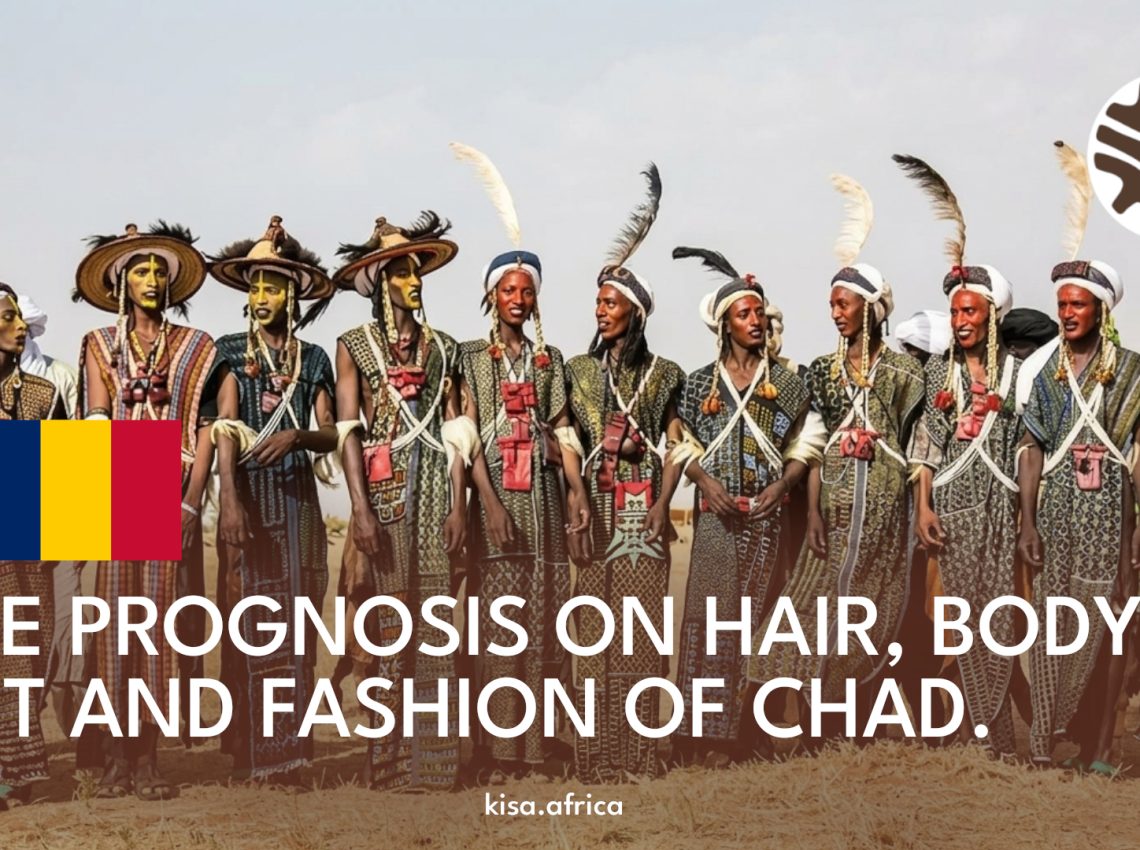
The Republic of Chad, the so-called Babel Tower of Africa, with immense ethnically mixed population, provides a very different experience. With more than 200 different ethnic communities, Chadian fashion is a living library of adaptation, environment and spirituality, which is decentralized. Adornment as a visual language of beauty standards, fertility, social status and survival can be seen in the nomadic Wodaabe pastoralists of the Sahel region and the Sara farmers of the south.
HISTORY BEHIND THE GEREWOL
The most typical embodiment of Chadian fashion, perhaps, is not a hairstyle, but an event, the Gerewol festival, of the Wodaabe (Fulani) people. The women in Western beauty pageants are the centre of attention, as it is the opposite in Gerewol. It is a male beauty pageant, which occurs at the end of the rainy season which normally happens in September, during which men take hours to beautify themselves to get a marriage partner.
The way it happened: The Gerewol, according to oral traditions, is associated with the nomadic lifestyle of the Wodaabe, who believe in survival of the fittest through perseverance and beauty. Since men spend most of their time herding cattle, the festival turned to be the main social marketplace to mingle and continuation of lineages.
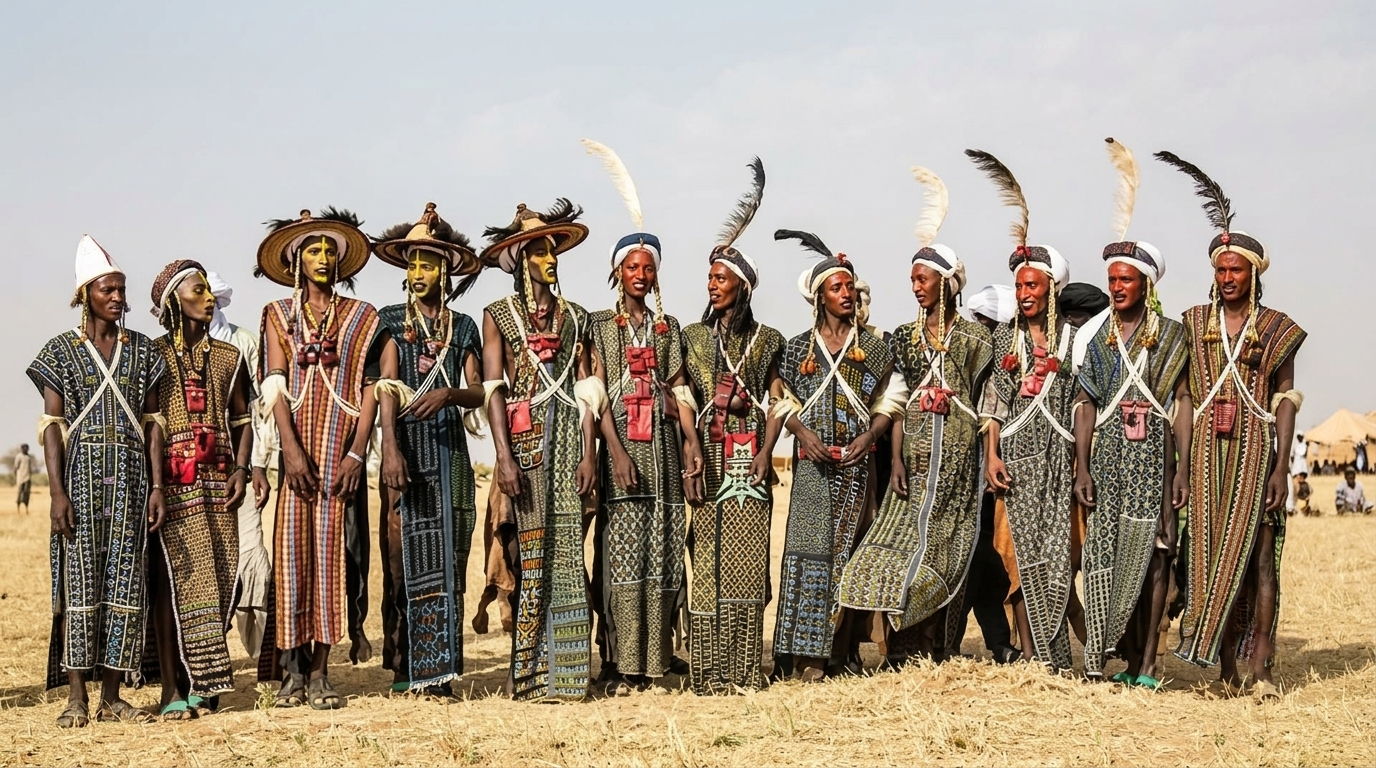
Wearing: Men use yellow ochre (a sacred earth colour) on their faces to lighten the skin, add black lines to lengthen the nose and add red and white decorations to highlight the eyes and teeth. They are adorned in fancy ostrich feathers, beads and fancy leather tunics to appear taller. It aims to attain a sweetness and symmetry aesthetics. They dance the Yaake to appear good-looking: rolling their eyes to demonstrate the whiteness of their sclera and left exposed with broad grimaces and baring their teeth.
Fun Fact: Many people believe that women are the judges of beauty contests but in Wodaabe, it is the women who have power over everything. The young women then walk the line, after the men have danced hours under the Saharan sun. By tapping a man on the shoulder, a woman had decided on him to spend the night with her- whether she is married or not. This can result in so called love marriages which replaces arranged family marriage.
THE HLEETA (SCARIFICATION) SECRET, AND THE SHRINE VESSELS.
The Ga’anda people of southern Chad and Nigeria use their skin. The Hleeta (ritual scarification) is used to make the female torso a sculpture.
Why is it worn? The demarcation of girlhood and womanhood is in the figure of Hleeta. Starting as early as age five, girls are given little slits in patterns on their stomach, back and faces. As one more stage of initiation is passed and as more bridewealth is paid to a suitor, more complex patterns (raised dots) are added.
Fun Fact: It is a severe procedure. The scarifier (specialist woman) scrapes the skin with a razor blade or thorn and rubs powdered charcoal or plant juice into the cut, to swell up the scar into a permanent keloid. This is not a mere decoration, but a wall map of social contracts that of how many cattle a woman is to be brought.
THE AZUWA OF CHAD: DANGALEAT HEADDRESS AND HAIR STYLES.
Fulani Braids: The Fulani braids (which are common among Chadian Fulani) have a particular origin although such braids are frequently copied all over the world today. They have cornrows which are flat against the scalp at the front and go down the back, or down the sides. The main feature is the giant braid on the side of the head in the centre, which is usually decorated with cowrie shells (a symbol of wealth and fertility) and brass beads. The cowrie shells in history were used as a kind of money, thus putting on the shells was metaphorically committing the wealth of your family to your head.
THE CORAL AND THE LOOM: TEXTILE OF THE SOUTH.
The traditional fashion of Southern Chad is based on the treadle loom. The Dangaleat people make white cotton cloth in its natural colour. The weaving of this Chadian contrasts with the Kente cloth of Ghana; it is plain and pure. The leading order of men attire includes the grand
Boubou (flowing gown), they are made of narrow strips of hand-woven cotton (about 6cm wide) that are combined. The only decoration is a hand-embroidered chain stitch around the neck opening.
White cotton is reflective to the sun in the hot Chad climate. Moreover, to many Chadian Muslims (and non-Muslims) white is a symbol of purity and spiritual peace, as opposed to the red of blood or danger.
HOME SPIRITUAL DIMENSIONS AND THE STRUGGLE TO SURVIVE.
Chadian fashion has a spiritualistic aspect to it.
Spiritual Protection: The brass and glass beads on the headdresses are not merely decorative but said to be a tiny guard against the so-called evil eye and evil spirits that could enter through the top of the head.
Modern Issues: Chadian traditional fashion is under the strain. Hleeta (scarification) is a dying art because of urbanization and health issues, albeit in village regions. More importantly Chadian law officially prohibited the practice of the excision (FGM) – which some Sara groups view as part of the traditional dressing code, or as purifying the body since 2022. Although 80 percent of the women in the Mandoul region are still scarified, the lack of the practice in this part of tradition is interpreted by activists as a win to human rights, providing a painful divide between conserving fashion and identity as well as preventing bodily damage.
Revival: Nonetheless, the Gerewol festival has emerged as an enormous tourist attraction and the Wodaabe have been able to make money off their fashion. In the meantime, in N’Djamena the young Chadian designers are starting to apply the geometric designs of scarification and paste them into contemporary fabrics, and to dissociate the “pattern” and the “pain” to preserve the visual culture.
SOURCES
Decalo, S. (1987). Historical dictionary of Chad. Scarecrow Press.
Lange, D. (2004). Ancient kingdoms of West Africa: Africa-centred and Canaanite-Israelite perspectives. J.H. Röll Verlag.
World Bank. (2023). Chad country overview. https://www.worldbank.org/en/country/chad
Stenning, D. J. (1959). Savannah nomads: A study of the Wodaabe pastoral Fulani of Western Bornu Province, Northern Nigeria. Oxford University Press.
Behrend, H., & Wendl, T. (1999). Snap me one! Studiofotografen in Afrika. Prestel.
Krätli, S. (2001). Education provision to nomadic pastoralists: A literature review. IDS Working Paper.
Cole, H. M. (1985). I am not myself: The art of African masquerade. UCLA Museum of Cultural History.
Barley, N. (1994). Smashing pots: Feats of clay from Africa. Smithsonian Institution Press.
Krutak, L. (2014). Spiritual skin: Magical tattoos and scarification. Schiffer Publishing.
Sieber, R., & Herreman, F. (2000). Hair in African art and culture. Museum for African Art.
Johnson, J. (1979). The cowrie currencies of West Africa. Journal of African History.
Picton, J., & Mack, J. (1989). African textiles. British Museum Press.
Allman, J. (2004). Fashioning Africa: Power and the politics of dress. Indiana University Press.
Gillow, J. (2003). African textiles: Colour and creativity across a continent. Thames & Hudson.
Spring, C. (2012). African textiles today. British Museum Press