
THE FASHIONABLE HISTORY OF ALGERIA
The origin of Algerian traditional clothes dates to the pre-colonial period when the residents of the area donned clothes made of animal skin covering the body in their necks and bracelets and earrings which were decorated with protective amulets composed of teeth, bones and stones and later developed to create ornate necklaces, bracelets and earrings. These fur garments over generations started to be dyed using natural pigments obtained out of roots, berries, and minerals, and were supplemented with decorative items and meticulously designed hairstyles, which created an advanced way of personal decoration that was never fully forgotten and still shapes the Algerian fashion now.
THE CHAOUI CLOAK: THE OLDEST FASHION IN ALGERIA.
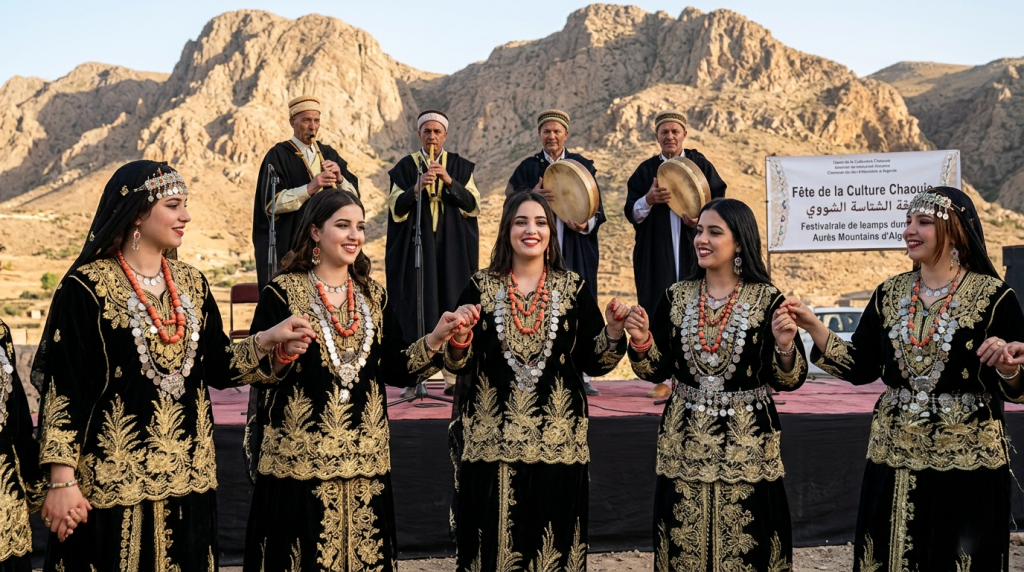
The Chaoui (Shawi) cloak of Berber women living in the Aurès mountains of eastern Algeria is perhaps the oldest garment to have been worn continuously in North Africa, dating back to the existence of the ancient Numidian kingdoms which thrived prior to and under the influence of the Greek and Roman presence in North Africa. Nevertheless, in spite of the long-term contacts with these strong Mediterranean people, the Amazigh women managed to keep their original dress, a wrapped garment called Melhfa or Hemelhafth made of a single and not broken piece of cloth about 4.5 meters long, traditionally of only two colours: black, which refers to the fertile soil of the Aurès mountains, and yellow, which symbolizes the sun and the freedom of the Amaz as the oral traditions are relayed by the generations of Chaoui women, the geometric symbols in the fabric symbolize the freedom and abandoning of the constraints and is a silent statement of Berber identity. The Chaoui cloak is nowadays a treasured and non-negotiable element of bridal trousseaus and great cultural festivals like weddings, festivals, and religious holidays.
THE RURAL URBAN FASHION RIFT.
It created a crisis of a deep and lasting division between rural Berber dress and the urban one which happened during the very early period of Algerian history with the influx of the coastal traders and settlers. Rural Berber clothing, still in use today, although in altered forms, in the Kabylie, Aurès, and Mzab areas, is a draped clothing, fastened with fibulae, ornamental brooches of bronze, iron or silver, that are among the first types of tailored clothing in North Africa. Silver jewellery is also popular among rural dress, as compared to the gold favoured in the urban areas, since silver was more easily available in the local mines, and was thought to have protective qualities against the evil eye. The wool fabrics, in which women have been woven on the upright looms since immemorial times by methods which have remained unchanged over thousands and thousands of years, are worn in the mountain and rural
conditions due to their warmth, strength, and resistance to water. The rural dress, the Melhfa, a draped wrapper, is, in fact, the immediate descendant of the primitive Numidian and Berber peplum. Urban seaboard fashion, in its turn, emerged under the significant influence of Mediterranean fashion and embraced gold jewellery, silk and velvet fabrics, more structured and tailored clothes.
THE ANDALUSIAN AND OTTOMAN REVOLUTIONS.
There are two historical developments that significantly changed the Algerian city fashion and produced the elegant clothes that are currently used in weddings and ceremonies. The initial was the Granada, when Andalusian (Moorish) families leaving Spain crossed the Mediterranean and settled in Algerian cities bringing with them new garments traditions such as advanced embroidery techniques with gold and silver threads, the caftan, velvet and brocade, and the Sirwal (baggy trousers).
These refugees also came with their music, poetry as well as their culinary arts, which blended with the Algerian traditions. The second significant change was the Ottoman period which started with the Ottoman rule taking control of Algiers through the corsair brothers, Aruj and Hayreddin Barbarossa, so the city became the capital of the Ottoman Algeria and its style the ultimate reference of other Algerian cities such as Tlemcen, Constantine, Annaba, and Oran. The migration of Moriscos, Sephardic Jews and Christian migrants of the western Mediterranean resulted in a slow hybridization of the Algiers fashion scene, women created vernacular versions of jackets and caftans that were very meaningful as well as useful in the Mediterranean climate.
THE HAIK: BEAUTY, PERSONALITY AND REVOLUTIONARY ICONIC.
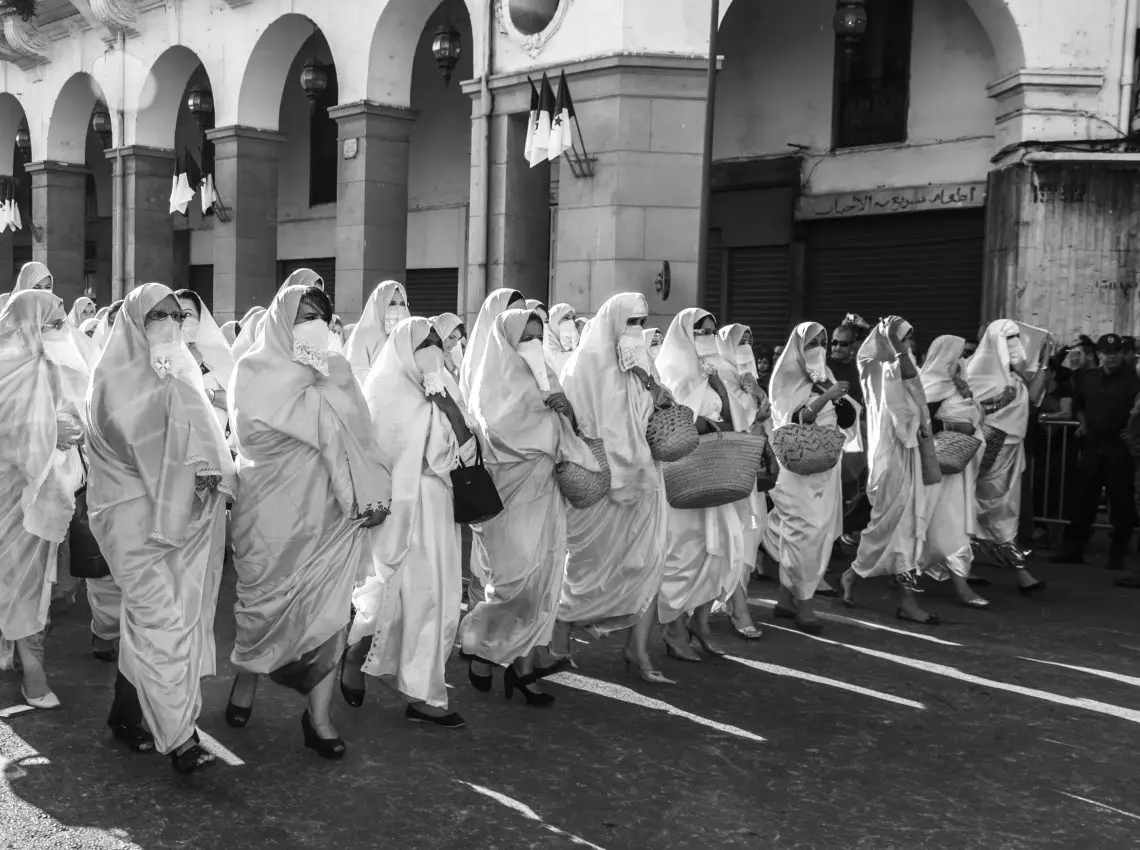
The Haik is, perhaps, the most traditional and emotionally loaded traditional piece of clothing in Algeria, a long and rectangular piece of white, cream, or black cloth that is a few meters and a little less than two meters long that envelops the whole body starting at the head and ending at the ankle, wrapped around the waist, and brought in front of the shoulders, and fixed with fibulae or crude pins. The Haik also emerged in Algeria with the arrival of Andalusian families that fled Spain and brought with them their clothing customs such as the use of fine white linen and elaborate draping styles although some researchers claim that similar body-covering garments were worn in Algeria even before that.
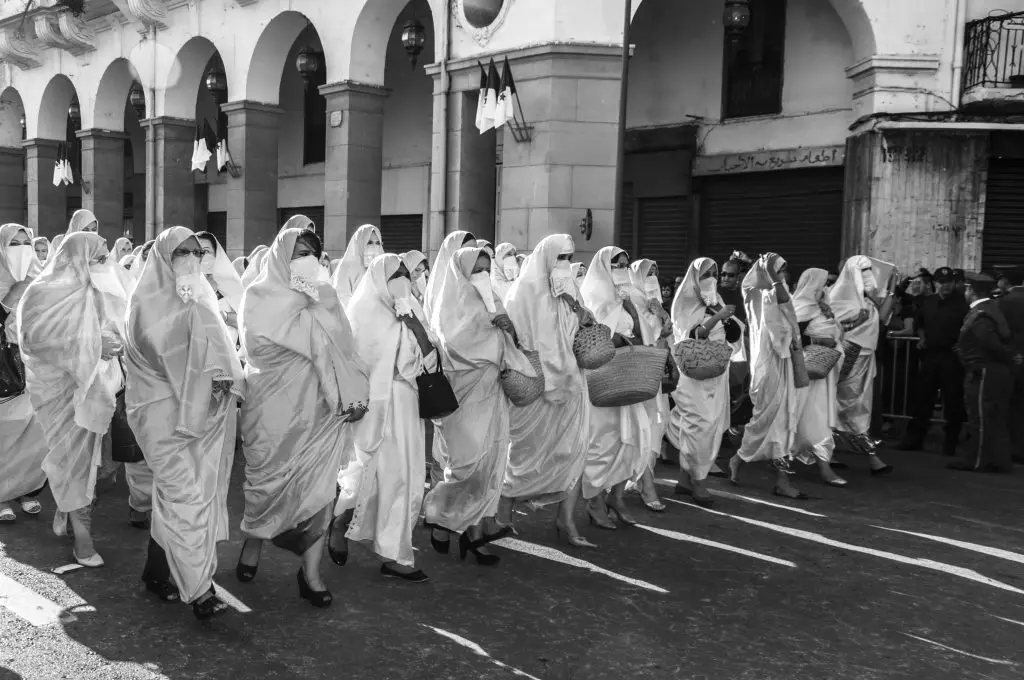
The Haik was known by various names in the various regions of Algeria: M’rama in the central part near Algiers and Blida worn with a Laâdjar, a small white linen veil over the lower face and leaving the eyes exposed and El Mlaya in the eastern part around Constantine a black version that began as a mourning garment, El K’sa in the western part around Tlem. The Haik had acquired a new and heroic connotation during the Algerian Revolution, where Mujahidat (women freedom fighters) wore the garment to pass without being noticed by French military checkpoints carrying bombs, weapons, money and messages under the folds of its voluminous garment. Male fighters also took advantage of the Haik as a disguise when they are operating in urban areas and wear the garment to fool the enemy. This two-sided position
was captured on screen in a film by Gillo Pontecorvo titled The Battle of Algiers and examined by the revolutionary Frantz Fanon in his book The Battle of Algiers, which took an entire chapter to exercise proper attention on the symbolism of the Haik during the colonial
period.
THE QASHABIYA: WINTER ARMOR OF THE FREEDOM FIGHTER.
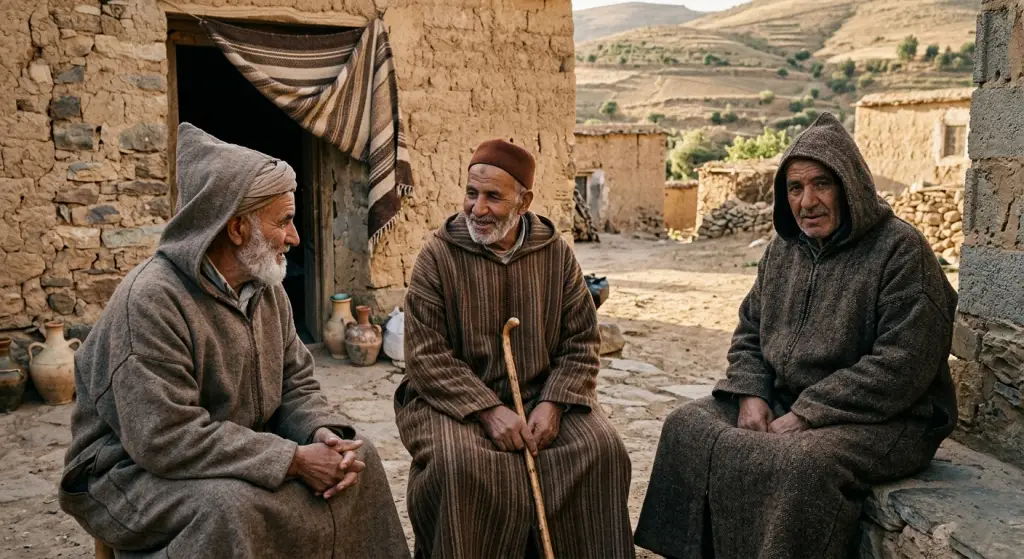
The Qashabiya is a men’s winter cloak, especially worn in the city of Djelfa and in the Ouled Nail region of the high plateaus of central Algeria, a hand-woven, hooded cloak composed of wool, camel hair, goat hair or a combination of both, which was intended to withstand the extreme cold, wind, and even snow of the mountainous areas of Algeria. A simple design of the Qashabiya might have originated in the ancient Greek civilization, which also included similar woolen clothes, such as the chiton and himation, which is an interesting bedrock to the Mediterranean long-standing interchange of textile creation. Women weave the Qashabiya on horizontal looms and the traditional methods of weaving have been transmitted down the generations, and even the patterns, colours and the style of weaving is different depending on
the region or even the family. The Qashabiya was a heroic clothing of resistance during the Algerian War of Independence due to a number of practical reasons: its heavy weight wool kept the wearer warm in cold mountainous hideouts, its loose voluminous fashion allowed the freedom fighters to carry weapons and supplies under its folds, and its natural earth colours provided the wearer with a high degree of camouflage in the rocky terrain. In the Ouled Nail, women in particular produced Qashabiya’s to be worn by Mujahideen to express support to the anti-colonial cause, occasionally concealing messages and symbols in the weaving. The Qashabiya is still a very influential sign of prestige, honour, and heroic pride, which is frequently presented to the invited guests, tribal leaders, and veterans today. It can take
master craftsmen as long as five months to make one high-quality Qashabiya using natural dyes obtained by using local plants, roots and minerals.
THE GHLILA: THE JACKET THAT BECAME THE CAFTAN.
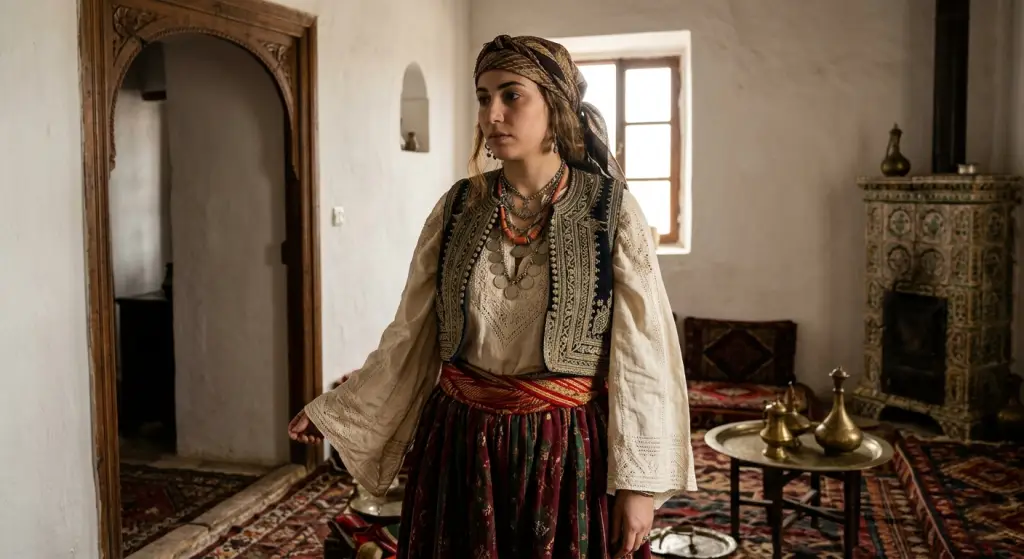
The Ghlila is a traditional jacket of Algerian origin, of a trapezoidal shape, crafted of the richest fabrics (velvet or brocade) with a deep oval neckline exposing the collarbone and upper chest, decorative buttons of gold or silver thread wrapped around cord and abundant embroidery with golden and silver threads in elaborate geometric and floral designs. Among the oldest and most useful historical sources of the Ghlila, then, is that provided by Diego De Haedado, a Spanish historian and ecclesiastical writer, who was made prisoner in Algiers, and who has written about women wearing voluminous blouses and long Cossacks, which he called, in phonetic form, Gholeyla (his phonetic spelling of ghlila), of velvet, sat The ghlila is a very important evolutionary step in the history of the Algerian fashion, with the Karakou, a
well-known Algerian vestmental jacket, still worn by brides, descending directly out of the ghlila and the Caftan of Algiers, a long garment that is worn over matching trousers and is open in front, is also a descendant of this rich tradition of tailored jackets. Gradually, Algerians put on a low-cut ghlila that reached the hip, had short sleeves and a single decorative button at the chest, and the long-sleeved ghlila Djabadouli worn by both men and women, but in different colour and ornamentation.
THE BURNOUS: THE CLOAK OF NOBILITY TO THE MAN.
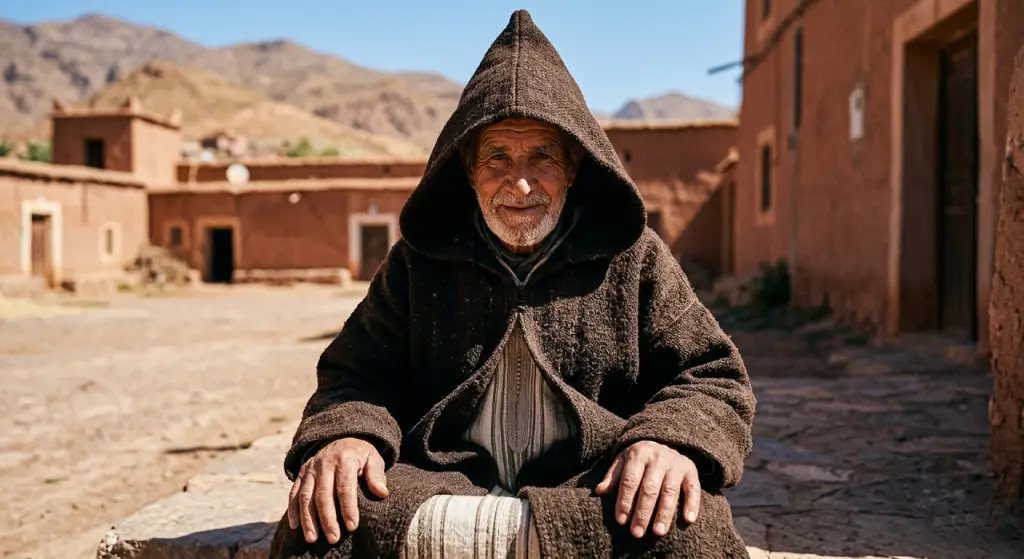
A burnous is a woollen cloak, floor-length and worn as a hooded cloak, worn by men of North Africa, between Libya and Morocco, and was used in the writings of the great philosopher and historian, Ibn Khaldoun, who referred to the burnous as a garment of the Berber and Arab tribes of the Maghreb, and stated that it was useful in the desert and mountain regions, and helped the burnous is usually woven out of the softest wool, and is sometimes of the fleece of the sheep that has grown in the high plateaus, and it may be plain white to be used every day, or beige or brown to be worn travelling, or dark blue or black on special occasions. The hood, which is referred to as qob, is pointed and it can be pulled forward to shield the face of the wind and sand. The burnous is an embodiment of male honour, dignity and leadership and was traditionally worn only by men who had attained some kind of status such as tribal chiefs, religious scholars, wealthy merchants, and warriors.
The burnous was also introduced as an official clothing of the deys and beys who ruled Algeria during the Ottoman period and later it was prohibited or limited due to its connection with Algerian identity and resistance during the French colonial period. A good burnous today, of handwoven and hand-embroidered cloth, may cost hundreds of dollars and is frequently handed down as a family heirloom, as well as worn to Friday prayers, weddings, and other formal events, in addition to the modern Western clothes.
THE KARDOUN: A STRAIGHTENING TRADITION THAT IS CHEMICAL FREE.
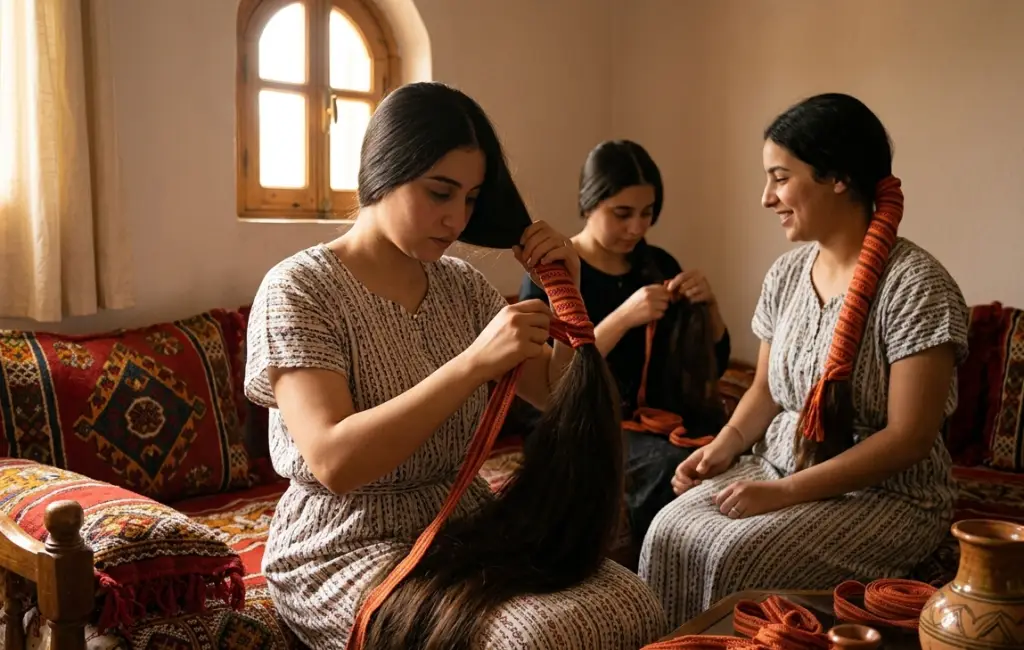
One of the most innovative and historically important traditional styles of hair in Algeria is the Kardoun or Qardoun a cold straightening technique which does not use heat, no chemicals or electricity, and is therefore completely natural and soothing to the hair. It is a long, narrow ribbon, composed of fine silk or soft cotton, of a bright colour, either red, orange, or yellow, which is wound round the head to make the hair flatten and remain in a straight position over a long period. The term Kardoun is based on the Arabic word Qarad, meaning to straighten or to flatten, and it is quite accurate since the main task of the
technique is the same. Kardoun usage in Algeria dates back several generations and traces back more than 200 years, and the usage of this product dates back even further than the invention of the chemical hair relaxers and ceramic flat irons. The method works by brushing and gathering the hair at the back of the head into a low ponytail, then wrapping the ribbon tightly around the head from the root of the ponytail toward the ends, wrapping multiple times to create a flat, smooth surface, and leaving it secured in place for an extended period, often overnight allowing the hair to gradually straighten under gentle, consistent pressure. Beyond being a practical hair accessory, the Kardoun is a deep symbol of Algerian cultural identity and heritage, passed down from mothers to daughters along with the techniques for
using it effectively. Many Algerian women take pride in wearing the Kardoun to connect with their cultural roots. In recent years, the Kardoun has experienced a revival in global pop culture and fashion, with the British brand ASOS releasing headscarves inspired by North African and Middle Eastern cultures that incorporated Kardoun designs, and the Kardoun being highlighted at cultural events such as the “North Africa United” exhibition in Paris.
THE BNIQA: THE POST-HAMMAM HAIR BONNET
The Bniqa or Bnika; known as Tabniqat in the Kabyle Berber language is a traditional Algerian women’s post-bath bonnet that originated in the coastal city of Algiers, evolving from the Chechia, a brimless, close-fitting conical cap made of felt or knitted wool, which was the only headwear worn by unmarried Algerian women in public for a very long time. Urban women of Algiers modified the simple conical cap by adding extending fabric panels on the sides, creating a bonnet that could be tied under the chin and that provided more coverage and functionality, specifically to dry and protect the hair after leaving the hammam, the traditional public bathhouse that was a central social institution for Algerian women.
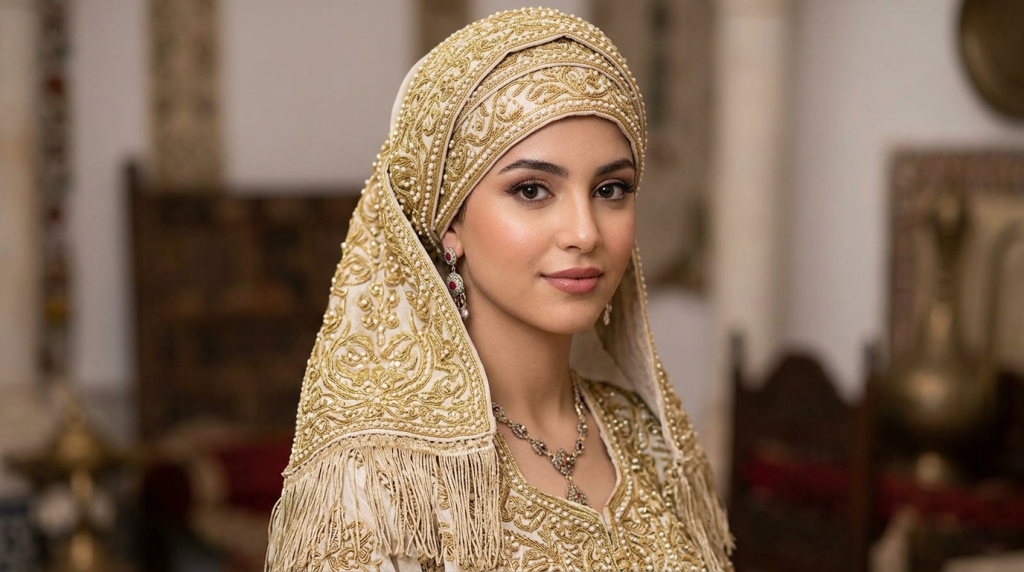
The Bniqa is constructed from two strips of cloth, each about 15 to 20 centimetres wide roughly 6 to 8 inches and over 50 centimetres long about 20 inches, richly embroidered with coloured silk threads and sometimes with gold or silver thread for wealthier women. The name Bniqa comes from the Algerian Arabic Binaka, which is derived from the Arabic verb Bannaka, meaning to gather, to tighten, or to bundle up, referring to how the bonnet gathers the hair. The English traveller Thomas Shaw, who travelled extensively through North Africa and published his observations, recorded that women of Algiers braided their hair into two long plaits that were carefully wrapped and tucked inside the Bniqa after being moistened with rosewater or orange blossom water. The Bniqa tradition spread from Algiers to other major Algerian cities as the capital’s fashion set the standard. In Tlemcen, women adopted their own
versions with specific regional motifs, including the distinctive Tlemceni embroidery known
for its dense geometric patterns and bright colours. In Kabylia, the Tabniqat was elevated to
the rank of bridal headwear, and it remains part of the bridal trousseau for women in many
major northern Algerian cities today.